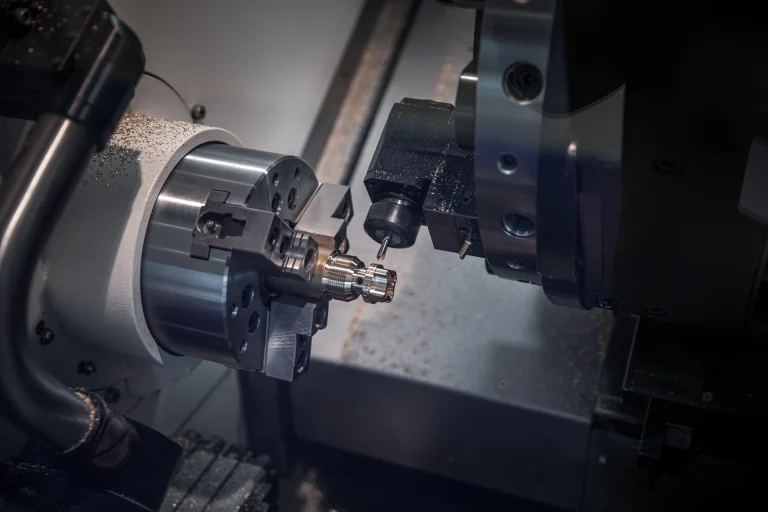
The defense industry demands a higher level of precision, safety and reliability than any conventional industry. The components that go into ground, naval, airborne and communication systems must operate under extreme conditions, withstand high loads and ensure consistent performance for years to come.
That is why manufacturing defense parts by CNC machining has become one of the key technologies to ensure that each component meets the most demanding standards.
In this article we analyze how these parts are manufactured, what requirements the defense sector demands and why MSJ Technology is a strategic partner for critical projects at national and international level.
What is machining for the defense sector?
Defense machining consists of manufacturing components for military systems using high-precision CNC machinery, advanced materials and extremely strict control protocols.
This industry requires parts capable of withstanding:
- Extreme vibration
- High temperatures
- Impact and fatigue
- Corrosive environments
- Minimum tolerances and dimensional stability
It is an industry where precision is not an option: it is a prerequisite.
Materials used in defense parts
At MSJ Technology we work with materials designed to offer resistance, lightness and safety in hostile environments.
High-strength aluminum (7075, 6082, 2024)
- Lightweight and robust
- Excellent for structural parts
- Ideal for mobile systems or systems requiring weight reduction
Titanium
- Extreme resistance
- Perfect for parts subjected to fatigue or high loads
- Excellent weight/strength ratio
Special steels
- High hardness and wear resistance
- Necessary in transmission parts, supports and loading mechanisms
Bronze and technical brass
- Stable and reliable
- Friction and corrosion resistant
- Ideal in mechanical components and precision systems
Each material is selected according to the system application and project requirements.
Advantages of CNC machining in the defense sector
CNC machining provides key benefits to meet military standards:
- Critical tolerances
Allows parts to be manufactured with micrometer precision, essential in pointing, transmission or control systems. - Advanced geometries
The CNC allows the manufacture of cavities, supports, guides and complex mechanisms without sacrificing quality. - Certified resistance
The process control guarantees stability, repeatability and reliability in each batch. - Full traceability
Each part is documented from the source material to its final shipment. - Durability under extreme conditions
Machined parts can operate under vibration, pressure, humidity or sudden temperature changes.
Defense CNC machining applications
CNC machining is essential in the manufacture of components for:
- Ground systems: tactical vehicles, transmissions, supports and fixings.
- Naval systems: mechanisms, anti-corrosion components, fastening parts.
- Military airborne systems: brackets, brackets, transmission components, structural parts.
- Communications and radar systems: housings, housings and precision parts.
- Drones and military UAVs: light structures, supports and mechanical elements.
- Armament and aiming systems: control parts, internal mechanisms and moving components.
Defense vs. industrial machining
| Feature | Defense sector | Industrial sector |
| Accuracy | Strict microns | High level |
| Materials | Military alloys | Wider variety |
| Control | Military protocol and full traceability | Control by sector |
| Fullness | Extreme environments | Variable |
| Coasts | High for technical requirements | More optimized |
Regulations and standards in the defense sector
The manufacture of defense parts requires compliance with protocols and standards that guarantee safety and reliability:
- Strict dimensional controls
- Non-destructive testing (NDT)
- Inspection protocols by lot and part
- Certified documentation for audits
- Material traceability
- Functional and mechanical verification
These processes ensure that each part is suitable for integration into critical systems without risk.
Export and defense machining
The defense sector requires compliance with:
- Technical certifications
- Documented controls
- Absolute repeatability
- Auditable manufacturing protocols
MSJ Technology manufactures parts for companies in Europe, the Middle East and Latin America that require components that perform under the most extreme conditions.
Quality control of defense parts
Quality control is a fundamental phase in the manufacture of military components.
At MSJ Technology we apply:
- High-precision CMM measurements
- Non-destructive testing (ultrasonic, liquid penetrant)
- Visual and dimensional inspections
- Functional and mechanical verification
- Complete project traceability
In the defense sector, the slightest deviation can compromise the security of the system, so our control is total and constant.
MSJ Technology: specialists in defense machining in Terrassa, Spain
With more than 40 years of experience, MSJ Technology manufactures high precision parts for defense companies in need:
- Reliable and rugged components
- High quality materials and certification
- Micrometer tolerances
- Prototypes and short series
- Strict quality controls
- Complete process traceability
Our investment in state-of-the-art machinery and our highly qualified team make us a strategic supplier for military and government projects.
📞 +34 93 655 05 35
✉ info@msjtechnology.com