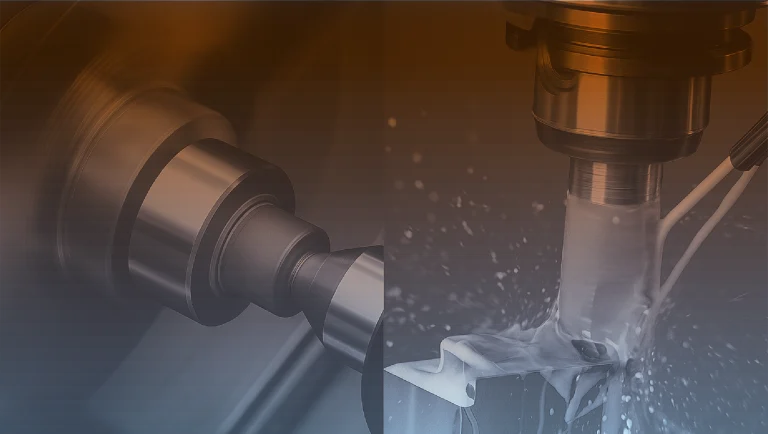
In precision machining, choosing the right process is key to ensuring efficient, durable parts with the quality required for each project. Among the most widely used techniques are CNC milling and CNC turning – two distinct processes that often raise questions about which one is the most suitable.
In this article, we analyze their main differences and help you decide which one best fits your needs.
What is CNC milling?
CNC milling involves machining parts with a rotating cutting tool that removes material in different directions. It allows the production of complex parts with high precision and a wide variety of geometries.
Advantages of CNC Milling:
- Ideal for flat surfaces, slots, cavities, and irregular contours.
- Highly versatile for manufacturing complex geometries.
- Ability to work with multiple axes for greater detail.
- Perfect for small series or customized projects.
What is CNC turning?
CNC turning works the opposite way to milling: instead of the tool rotating, it is the workpiece that rotates. Layers of material are removed until the desired shape is achieved.
Advantages of CNC Turning:
- Specialized in cylindrical or spherical parts.
- High precision in diameters and symmetrical axes.
- Faster for large series of identical components.
- Cost-effective for repetitive production.
Key Differences Between CNC Milling and CNC Turning
| Feature | Fresh CNC | CNC turning |
| Motion | The tool rotates, the workpiece remains fixed. | The workpiece rotates, the tool cuts. |
| Geometry | Flat, prismatic, or complex-shaped parts. | Cylindrical, spherical, or symmetrical parts. |
| Precision | Excellent for irregular contours and cavities. | Magnificent in diameters and longitudinal axes. |
| Production Volume | Ideal for short series or prototypes. | More efficient in long and repetitive series. |
| Versatility | High, it allows to work multiple materials and designs. | More specialized, focused on rotational parts. |
When to Choose CNC Milling or CNC Turning?
- Choose CNC milling if you need parts with complex shapes, flat surfaces, cavities, or designs that require high versatility.
- Choose CNC turning if your project requires cylindrical, rotational parts or large-scale production of standardized components.
In many cases, the two processes complement each other: the same part may require initial turning for its basic shape and subsequent milling to add details.
CNC milling and CNC turning are complementary processes in precision machining. Choosing one or the other will depend on the type of part, design complexity and production volume.
At MSJ Technology we have advanced machinery and a specialized team to offer you customized solutions, either with CNC milling, CNC turning or a combination of both.
Do you need advice for your next project? Contact us.
📞 +34 93 655 05 35
✉️ info@msjtechnology.com